"At this time last year, everyone was still imagining the beautiful bubble of AIGC. After many companies practiced it, the gap between ideal and reality gradually became visible."
At the 2025 CMAC annual meeting, MeDomino CEO Lu Wenqing said directly, "This year's atmosphere feels more like a sober post-battle review. AI's real opportunity may not lie in areas of consensus, but in the easily overlooked areas of non-consensus - those implementation problems that have not been widely discussed."
*This article is based on a speech delivered by MeDomino CEO Lu Wenqing at the 2025 CMAC annual meeting.
Starting From an "AI vs. Human" Debate
On the second day of CMAC, we hosted an AI vs. human debate. Four human contestants and five AI contestants, plus one agent commanding behind the scenes, debated on stage, and the room was packed.
The debate had two rounds. The first used Doubao. Then the affirmative and negative positions were switched, and the model was changed to DeepSeek-R1.
One detail left a strong impression on me:
- After a human debater finished speaking, or even made an unintentional pause that the model treated as the end of the speech, Doubao could respond in almost two seconds and begin presenting its view. It was fast, but its statements were mostly conclusions without supporting evidence.
- DeepSeek could listen carefully to a long, complete human speech and only respond after the human said "speech finished." But it required about 10 to 20 seconds of waiting, and we could hear DeepSeek cite a large amount of data to support its argument, although that data was later proven to be fake.
This small difference exposed an obvious shortcoming of current AI capabilities in real application scenarios: speed and quality are hard to have at the same time. Even more concerning, AI either gives "correct nonsense" without evidence, or directly fabricates data. During the debate, AI cited reports that did not exist and confidently named several well-known pharma companies.
This made me realize that the first lesson of AI implementation is learning to coexist with its imperfection.
Build a Ship or Build a Tower?
In 2024, our company had an intense internal debate over whether to develop our own model. In the end, we decided not to start yet, because we sensed that large models would iterate rapidly and the overall foundation was not stable. If a flood came, would the tower we built ourselves not collapse?
But this year, we chose to step in. My solution is "shipbuilding logic": do not chase the waves of general-purpose models, but train specialist small models for specific scenarios.
I believe the future will be a "commander + experts" model, where one general-purpose model dispatches multiple vertical small models, each doing its own job.
We have served many large pharma companies and seen massive amounts of data:
- It may be scattered across dozens of systems.
- It may be messy in format.
- It may even lack labels.
- ...
Using this data to train a general-purpose large model is like building your own tower: difficult and inefficient. If we instead use shipbuilding logic, let AI and humans collaborate, and continuously produce high-value data through the process, the result can be better.
In a typical scenario, such as precise physician engagement, while large models are still struggling with "how to answer academic questions," our small models can already combine an HCP's past meeting records, reading habits, social dynamics, and even past engagement process data to directly tell you what content a certain HCP is suited to read, when you should contact them, and what topics you should suggest. The value of such specialists lies in their deeper understanding of the small pains inside business capillaries.
Another example is when medical information teams respond to physician inquiries, use AI to generate first drafts, and manually revise final drafts. These actions generate "comparison data" that records professionals' decision logic. As models upgrade, this data rises in value and becomes the golden fuel for training the next generation of models. That is the real future core competitiveness.
Q&A Is Not the Destination; Scenarios Are the Throne
Some say the future belongs to intelligent Q&A. But after testing it hundreds of times, we reached the opposite conclusion. I want to say that users may not know what AI can do at all.
- According to our real enterprise usage data, once AI Q&A went live, the number of questions was huge, but usage soon dropped.
- Meanwhile, preset function buttons such as One-Click Translation saw growing usage.
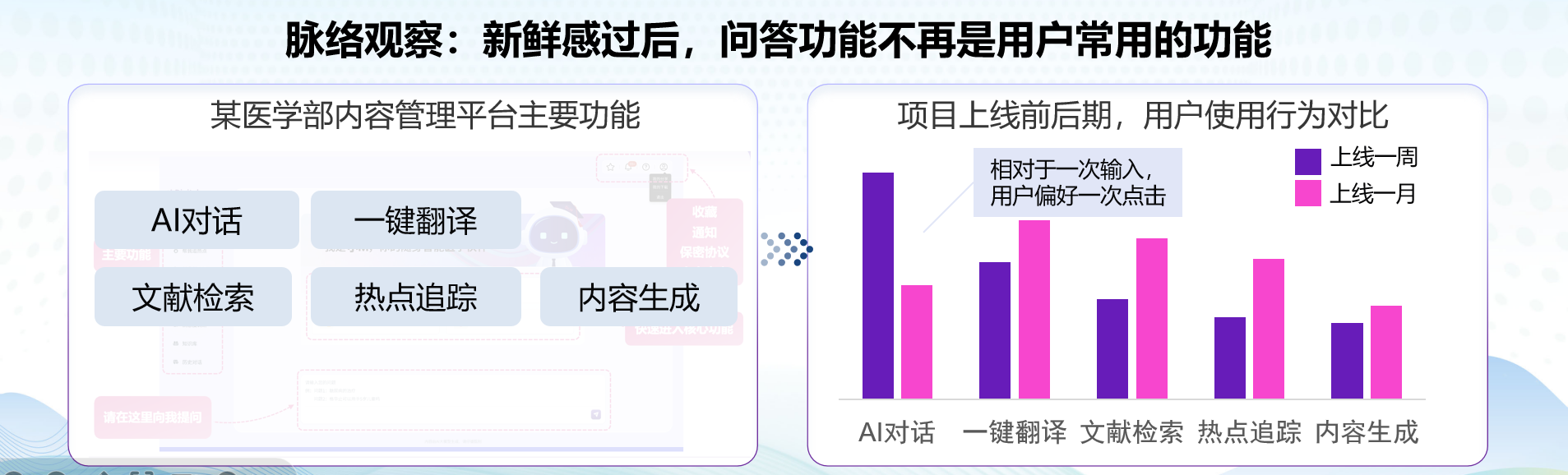
Many people now use AI like a search engine. But in enterprise applications, AI and search engines follow very different logic. The reason is simple: users will not craft prompts for every question, and they do not want to tolerate "correct nonsense." If a button can solve the problem, why should I type a paragraph?
In fact, without a preset One-Click Translation button, users might not even know AI can help them translate literature. After trying a few times and failing, they may abandon AI entirely.
This leads to another non-consensus point: popular intelligent Q&A is better suited for long-tail scenarios. In high-frequency must-have business scenarios, preset functions are far more important than open-ended Q&A.
To put it simply, when ordinary people take photos with their phones, few manually adjust parameters every time. They tap Portrait Mode or Night Mode. That is the logic of preset functions. We have shared more about preset scenarios in previous articles. Read more >>> Multi-Scenario Intelligent Conversation for Frontline Reps Facing Professional Questions
Content Revolution: Precise Engagement Matters More Than 100,000+ Views
Speaking of scenarios, content inevitably comes up. Every business scenario depends on content. At the same time, AI is creating an even greater volume of content.
Through cooperation with life sciences companies and our own hands-on attempts, we reached another brutal non-consensus: quality does not equal traffic. High-quality professional content that companies painstakingly polish may simply become an exquisite display item that no one notices.
Behind this is a cognitive revolution around content. In the future, companies will not worry about the quantity of content. Personalization will be the real key. Without exaggeration, instead of chasing 100,000+ views, it is better to deliver content precisely to a small number of the right people, at the right time and in the right format. Precise engagement efficiency, or read rate, is gradually replacing broad exposure volume, or view count, as the core metric of content marketing.
Final Thoughts
I have always believed that AI is not a myth, and AI in healthcare is even less of a myth. Consensus can help everyone move in the right direction together, while non-consensus is the undercurrent that drives enterprise development.