Digital Intelligence Rebuilds Drug Promotion: From Efficiency Improvement to Value Resonance
As the pharma industry shifts toward compliance, refinement, and value, digital intelligence is no longer an auxiliary nice-to-have. It is core support for rebuilding the logic of drug promotion and breaking growth bottlenecks. MeDomino, focused on AI + digital marketing for life sciences, reveals the core path for improving promotion results through deep product-system penetration across promotion scenarios. This is not simple tool replacement. It is a full-dimensional value reconstruction across resource integration, scenario adaptation, ecosystem linkage, and risk prediction.
1. Resource Integration: Break Information Silos and Achieve Precise Full-Domain Reach
In traditional drug promotion, resources across marketing, sales, and medical affairs are scattered, and HCP data is fragmented. This makes promotion actions fragmented and reach inefficient. One core value of digital intelligence is integrating full-domain resources through technology, allowing promotion resources to work together and precisely reach target audiences.
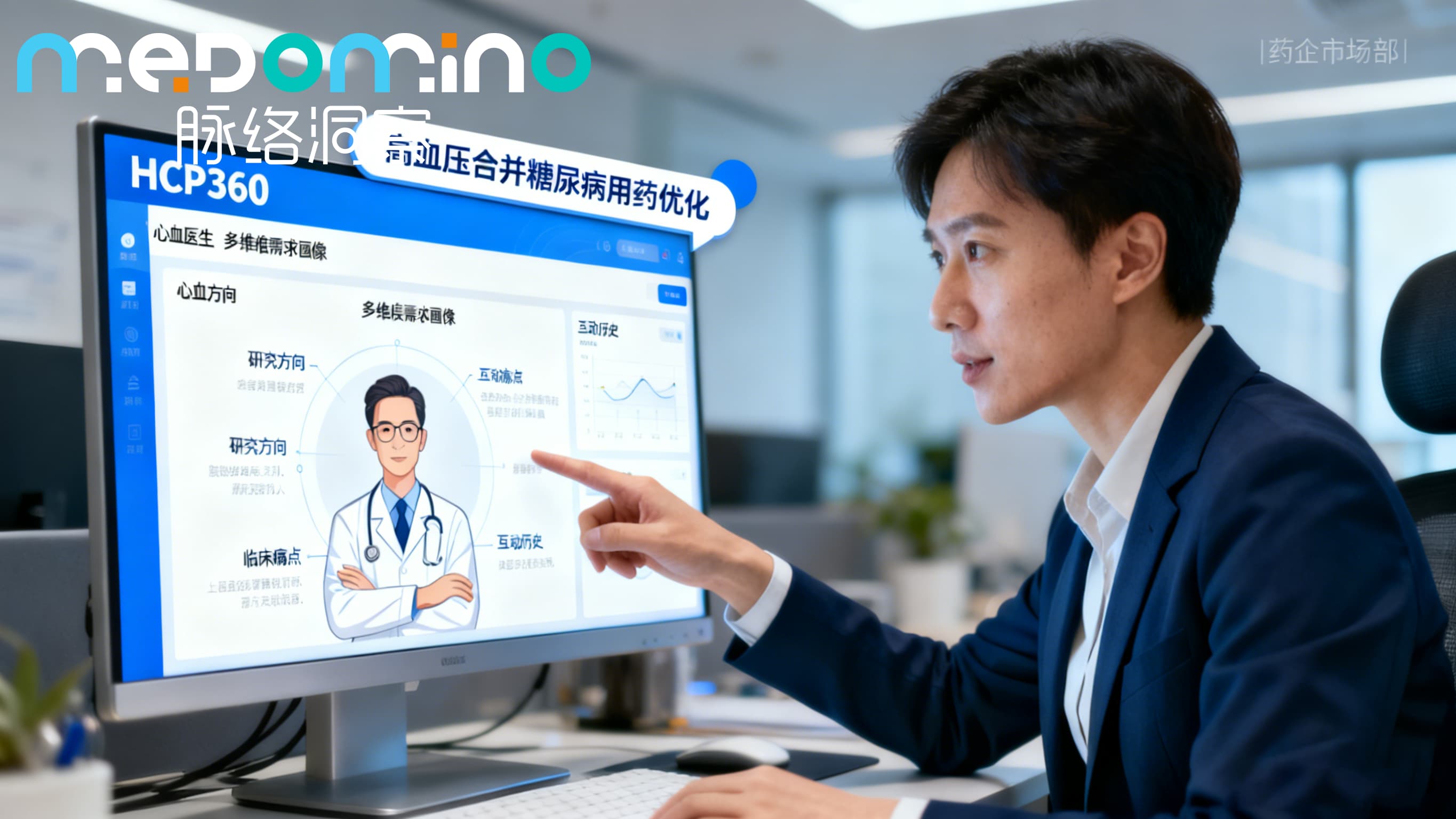
MeDomino's full-domain resource integration system breaks information barriers and data silos between departments. Through tools such as MeDomino HCP Navigator, it integrates HCP academic updates, clinical needs, interaction history, and other multisource information into a unified promotion resource pool. Pharma companies no longer need to rely on limited resources from a single department. From a full-view perspective, they can allocate suitable academic content, activity resources, and communication strategies to achieve one-stop precise HCP reach.
This integration is not simple information stacking. Intelligent algorithms classify, match, and optimize resources. For example, clinical trial data, guideline interpretations, and clinical case analyses for a drug can be packaged and precisely pushed to HCPs focused on that therapeutic area, maximizing promotion resource utilization and avoiding ineffective dispersion.
2. Scenario Adaptation: Fit Clinical Reality and Embed Promotion Into the Care Process
The core scenario of drug promotion is clinical practice. Traditional promotion often disconnects from physicians' diagnosis and treatment rhythm and intervenes through one-way selling, easily causing resistance. The key breakthrough of digital intelligence is deep adaptation between promotion scenarios and clinical scenarios, allowing value communication to integrate naturally into the care process.
MeDomino's product design fully reflects scenario thinking. MeDomino ACE, the frontline customer engagement assistant, does not simply provide communication scripts. It provides promotion methods adapted to physicians' daily work scenarios, such as outpatient gaps, academic discussions, and case consultations. For busy clinical physicians, it pushes concise product core value and clinical application points to avoid taking too much time. For experts joining academic discussions, it matches deep content such as frontier academic views and research data. For physicians conducting case consultations, it provides solution references related to cases, supporting clinical decision-making.
At the same time, MeDomino Content Hub supports customized content generation for different scenarios, allowing promotional content to perform well across contexts and truly deliver the right value in the right way at the right moment.
3. Ecosystem Collaboration: From One-Way Promotion to Two-Way Enablement and Long-Term Trust
Traditional drug promotion is mostly one-way information delivery from pharma companies to HCPs. It lacks effective interaction and value feedback, making long-term trust hard to build. Digital intelligence creates an ecosystem collaboration model of two-way enablement, turning promotion into a link for joint growth between pharma companies and HCPs rather than a purely commercial action.
MeDomino's digital ecosystem provides a path for two-way enablement. By building a digital platform for academic exchange, HCPs can conveniently access academic resources, research support, and training opportunities provided by pharma companies. They can also feed back clinical practice problems, product experience, and improvement suggestions through the platform. Pharma companies can then use this feedback to optimize product development direction, improve academic support systems, and adjust promotion strategies, forming a positive cycle of promotion, feedback, optimization, and renewed promotion.
For example, pharma companies can use MeDomino tools to invite HCPs to participate in multicenter clinical research, case collection, and other academic activities, turning HCPs from promotion recipients into academic participants. At the same time, they can provide personalized academic growth support, such as recommending collaboration opportunities based on research direction and offering guidance for academic publication. Promotion becomes a process of value co-creation. This ecosystem collaboration model moves beyond short-term thinking and builds long-term professional trust, allowing promotion results to accumulate continuously.
4. Risk Prediction: Build Compliance Defenses Early and Protect Promotion Sustainability
Compliance requirements run through the full promotion process in pharma. Traditional promotion often controls compliance after the fact, making risk hard to avoid in advance. Once violations appear, they can affect promotion results and cause serious losses for the company. One core advantage of digital intelligence is early prediction and full-process control of compliance risk, protecting sustainable improvement in promotion results.
MeDomino's product system embeds compliance risk prediction logic from the bottom layer. The intelligent compliance review function of MeDomino Content Hub does not only check content after generation. It warns of risks during creation, such as cited data without source notes, wording that may imply exaggerated promotion, or content inconsistent with product instructions, helping creators correct issues in time and reduce compliance risk at the source.
Conclusion: Digital Promotion Is Essentially a Return to Value
Using digital intelligence to improve drug promotion is essentially about returning promotion to clinical value. Resource integration makes value delivery more precise. Scenario adaptation makes value delivery more natural. Ecosystem collaboration makes value delivery more durable. Risk prediction makes value delivery safer. MeDomino's practice proves that digital intelligence is not a simple stack of technologies, but a deep reconstruction of drug promotion logic.
For pharma companies, the core of digital promotion is not short-term exposure, but building a long-term value ecosystem. With industry-focused digital tools such as MeDomino, pharma companies can move beyond the path dependence of traditional promotion, shift the focus from selling products to creating value, build deep resonance with HCPs under compliance, and ultimately improve both promotion results and brand value while standing firmly through industry change.