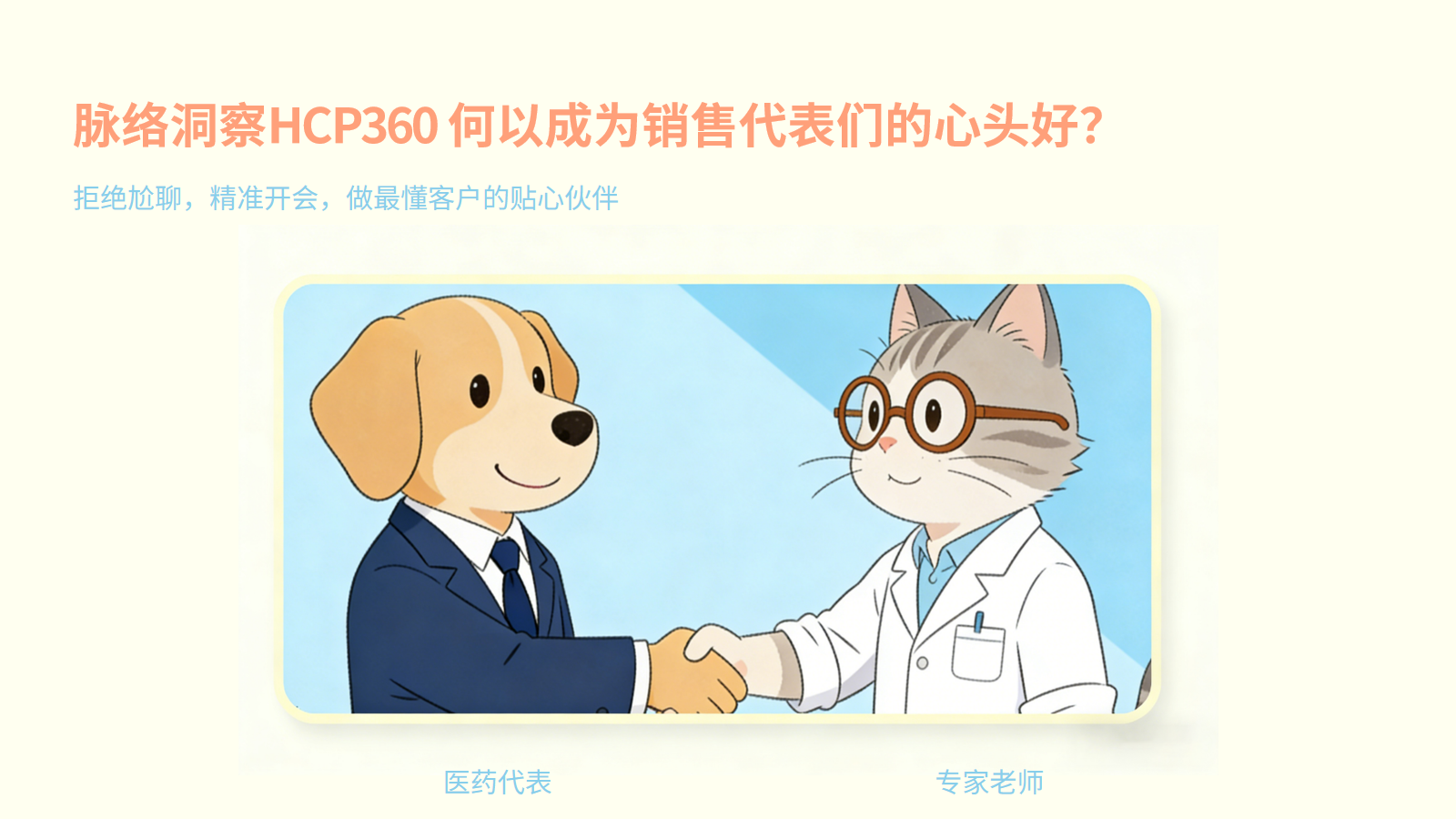
Digital marketing in pharma once stayed at the stage of HCP360 data collection: integrating basic physician information such as departments, titles, and academic experience, assuming that mastering these data would enable precision marketing. But actual results often fell short. Data was scattered and hard to implement, real physician needs were unclear, and strategy depended on manual judgment, making it difficult to adapt to market changes in time.
Today, as AI technology becomes deeply integrated with the industry, digital marketing is moving from data collection into a new stage of AI-driven insight and strategy. MeDomino, focused on life sciences, clearly outlines the core logic of this transformation through the combined practice of HCP360 and AI: turn data from static information into dynamic insight, and turn strategy from manual design into intelligent recommendation.
1. The Limits of Traditional HCP360: Data Without Action Guidance
Early HCP360 tools mainly focused on data integration, gathering HCP information scattered across channels into unified profiles and solving information silo problems. But for frontline marketing, such tools still have clear shortcomings: most data is static basic information and lacks deep interpretation of needs, attitudes, and scenarios. For example, knowing that a physician is an associate chief physician in cardiology does not tell you whether they recently care about medication plans for hypertension with kidney disease or safety data for new antihypertensive drugs. Knowing that a physician attended an academic meeting does not reveal their core view on the meeting topic.
This model of storing data without interpreting it leaves marketing stuck in blind trial and error. Marketing teams can only build generic strategies from basic data, and sales reps communicate with static information that neither hits physicians' real needs nor helps them quickly adjust the conversation direction. At this point, HCP360 is more like a data warehouse than a marketing assistant: it contains massive information but cannot provide clear action guidance.
2. AI-Empowered HCP360: From Data Records to Customer Insight
The addition of AI creates a qualitative leap for HCP360. It no longer only records data, but interprets data and generates insight. MeDomino HCP360 uses AI algorithms to turn static data into dynamic customer understanding, truly reading HCPs' implicit needs and changes in views.
The core role of AI is deep analysis and association across multidimensional data. It integrates physicians' academic papers, conference speeches, clinical feedback, past interaction records, and other content. Through natural language processing and behavior trajectory analysis, it accurately judges academic tendencies, clinical pain points, and research needs. For example, by analyzing keywords in a physician's published papers, it can identify the specific subfield they are studying. By tracking their questions at academic meetings, it can capture their focus on certain treatment plans. Based on interaction records, it can even predict communication preferences, such as whether they prefer deep academic data or clinical case sharing.
More importantly, these insights update dynamically. When physicians adjust their research directions or their clinical needs change, AI updates the insight results in HCP360 profiles in real time, keeping marketing teams and sales reps aligned with the latest customer dynamics. If an oncologist recently begins focusing on mechanisms of immunotherapy resistance, AI can capture the change and synchronize it to relevant teams, allowing marketing communication to follow up quickly and avoid wasting resources on outdated assumptions.
3. AI-Driven Strategy Recommendation: From Manual Design to Intelligent Adaptation
If AI enables HCP360 to understand customers, its greater value is turning insight directly into actionable marketing strategies. This is the core advantage of MeDomino AI tools. In the traditional model, marketing teams must organize people to analyze HCP data and discuss strategic directions. This takes time and is easily affected by subjective experience. AI can automatically recommend precise strategic suggestions based on HCP360 insights, shifting marketing from passive response to proactive adaptation.
MeDomino Strategy Intelligence is the implementation carrier for this logic. It directly calls HCP360 AI insights and automatically generates personalized strategies for different HCP needs and scenarios. For physicians focused on clinical practice, it recommends product application cases in complex cases as the communication core. For research-oriented experts, it matches relevant multicenter clinical research collaboration opportunities. For physicians needing patient education support, it pushes easy-to-understand patient education material packages.
On the frontline sales side, MeDomino ACE turns strategic suggestions into instant action guidance. Before a visit, AI may remind the rep that the physician has recently focused on a certain diagnosis and treatment challenge and suggest bringing related solution materials. During communication, AI can support real-time intelligent Q&A so the rep can obtain answers on site, greatly reducing the time cost of medical inquiry. After the visit, AI can suggest sharing a relevant academic paper next time. This immediate conversion from insight to strategy to execution means sales no longer has to guess needs or topics, but can act precisely along the direction recommended by AI.
4. The AI Closed Loop: Marketing Strategies Optimize Themselves and Keep Adapting
The most important breakthrough in AI-enabled digital marketing is a closed loop of data, insight, strategy, execution, feedback, and optimization. In traditional marketing, strategy adjustment depends on manual summary and often lags behind market change. MeDomino AI tools can automatically track strategy execution results and feed them back into HCP360 insight models, allowing strategies to self-optimize.
For example, after a certain type of academic content is pushed to target HCPs, AI automatically analyzes open rates, interaction frequency, and feedback. If physicians show strong interest in real-world research data, later strategies increase the weight of this content type. If a communication topic receives low response, the topic direction is adjusted and redesigned based on physicians' latest updates. This closed-loop operation makes HCP360 insights increasingly precise, AI strategy recommendations increasingly practical, and marketing effects continuously improve. It is no longer a one-off effort, but a dynamic process that keeps adapting to market and customer needs.
Conclusion: AI Does Not Replace HCP360; It Makes HCP360 Truly Enable Marketing
From HCP360 to AI, the next stage of pharma digital marketing is not about abandoning data. It is about using AI to generate action value from data. MeDomino's practice shows that AI does not replace HCP360. It turns HCP360 from a data warehouse into a marketing brain that understands customers, provides precise strategic suggestions, and continuously optimizes.
For pharma companies, this transformation means marketing no longer depends on the experience judgment of a few people. Instead, it can achieve precise, efficient, and compliant growth based on objective AI insight and intelligent recommendations. When static HCP360 data meets AI's dynamic interpretation and strategy generation, digital marketing can finally move beyond formality and become a core driver of business growth. This is the future direction of pharma digital marketing and the core mission of MeDomino in enabling the industry through technology.