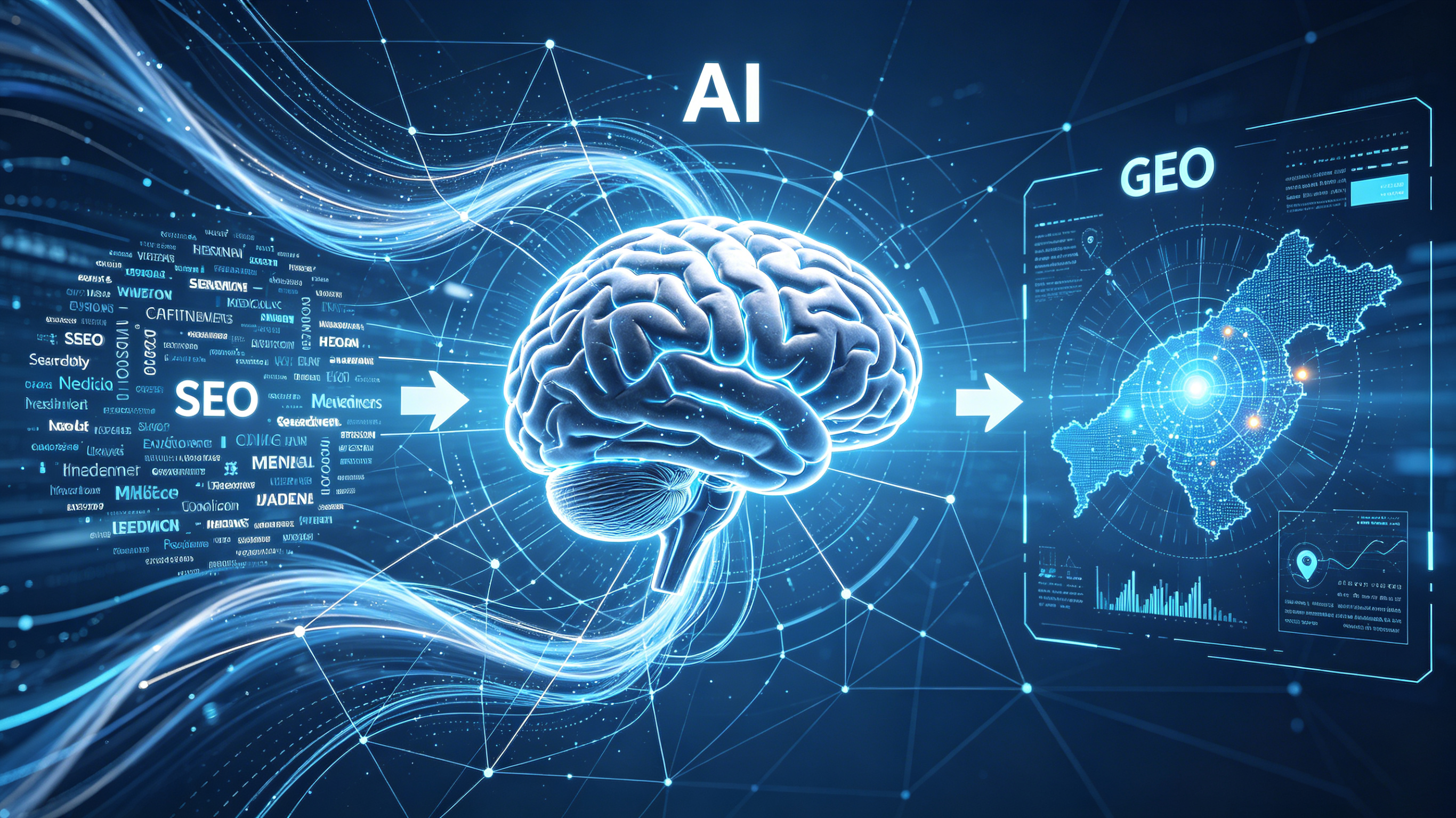
As the internet information retrieval ecosystem continues to evolve, the user decision path in medical aesthetics is undergoing a fundamental change. Traditional marketing models based on search engine keyword rankings and community recommendations are becoming less efficient. GEO, or Generative Engine Optimization, built on large-model AI search and Q&A ecosystems, is becoming a new track for injectable aesthetic products such as hyaluronic acid and botulinum toxin to break through user reach. As a service provider deeply focused on life sciences digital intelligence marketing, MeDomino combines years of industry compliance and user insight experience to clarify the underlying logic differences between SEO and GEO. With a mature GEO methodology, we implement practical projects for medical aesthetic products, helping brands accurately communicate product effect value in AI answers and build professional, trusted brand perception.
1. SEO and GEO: Different Marketing Logic in Two Information Ecosystems
1. Traditional SEO: passive exposure in the keyword search era
Traditional SEO is rooted in general search engines. For medical aesthetic products such as hyaluronic acid and botulinum toxin, marketing focuses on product keyword planning and professional content recommendations. Users need to actively enter keywords such as "hyaluronic acid brands," "botulinum toxin effect," "sensitive skin medical aesthetics," and "post-procedure repair," then screen and compare product information across massive search results and community posts. Brands can only wait passively to be discovered. Information delivery is fragmented, and effect presentation is not precise.
This model was the mainstream approach for medical aesthetic product promotion for a long time. But as generative AI becomes more common, target users' habits for obtaining medical aesthetic information are changing dramatically, and the original traffic growth logic is increasingly limited.
2. GEO: new rules for active value delivery in the AI-generated Q&A era
GEO means Generative Engine Optimization. It adapts to the new information environment of professional Q&A powered by large AI models. Today, people seeking aesthetic treatment are gradually no longer searching scattered information one query at a time. Instead, they ask AI complete need-based questions, such as "which hyaluronic acid brand looks natural for filling," "how long does botulinum toxin last for jaw slimming," "can sensitive skin receive medical aesthetic procedures," "how should I repair skin after a procedure," "which hyaluronic acid works best for temple shaping," and "what is the difference between imported and domestic botulinum toxin." AI integrates information from across the web and generates direct answers.
The core of GEO is to optimize the exposure probability and presentation accuracy of product effect information in AI-generated answers, and to correct AI misunderstandings about indications, effect duration, and suitable treatment areas. It upgrades the goal from "letting users find links" to "letting AI accurately present the brand's core effect advantages." It is a new-generation content optimization system that fits compliance requirements in the medical aesthetics industry.
2. MeDomino's GEO Implementation Thinking: Anchored in Real Medical Aesthetic Decision Scenarios
MeDomino's GEO service logic for medical aesthetic categories is grounded in product characteristics and user decision patterns. Instead of using generic optimization templates, it builds an optimization system anchored in user needs and AI rules:
1. Anchor content direction in high-frequency target user questions
We go deep into medical aesthetic consumption scenarios, understand core target groups such as people seeking aesthetic treatment, and focus on the core concerns they care about most: effect duration, indication scope, post-procedure repair, and special skin types such as sensitive skin. This fits users' decision habits, where effect authenticity and safety are highly valued, and helps us map the real questions users ask AI in daily life.
2. Refine product materials according to large-model professional answer generation rules
We build brand content systems around real user questions and fully adapt them to AI content generation logic. From clinical effect data, authoritative certifications, indication scope, usage suggestions for different areas, and safety data, we improve brand-owned content assets to ensure professionalism and compliance, giving AI enough credible effect evidence when it integrates answers.
3. Iterate through long-term data tracking
We use a periodic long-term operating model to monitor brand mention data and effect information accuracy across AI Q&A scenarios in stages. Based on effect description deviations in AI answers, we continuously optimize content and gradually improve the brand's priority and credibility in AI recommendation systems.
3. MeDomino Implementation Case: Practical GEO for Medical Aesthetic Products
Products such as hyaluronic acid and botulinum toxin have very high penetration in the medical aesthetics market. User decisions focus heavily on product effect comparison, safety, and brand reputation differences. This category has become a benchmark medical aesthetic scenario for MeDomino's GEO solution.
GEO pain points in medical aesthetic categories
1. Target users in medical aesthetics are strongly influenced by community and social media opinion. Reviews from users who have purchased or received procedures vary widely. When AI answers questions, it can easily be disturbed by scattered word-of-mouth information and fail to present the brand's core effect advantages accurately.
2. Different brands' indications and effect characteristics are not always clearly differentiated. AI-generated answers are often generic, making it difficult to communicate the brand's unique effect selling points precisely.
3. Some sources contain biased product effect descriptions, causing unstable AI outputs, creating user concerns about product effects, and affecting brand recommendation tendency.
MeDomino's GEO implementation actions
Step 1: User need analysis - restore real medical aesthetic decision scenarios
Based on years of MeDomino user insight experience, we use user probes and demand modeling to accurately identify the core target groups for injectable aesthetic products, such as people seeking medical aesthetic treatment, and deeply analyze their decision focus and information paths under different aesthetic needs.
- Systematically map full-dimensional consultation scenarios for target users around medical aesthetic products, focusing on high-frequency question directions such as effect comparison, indication selection, area fit, safety evaluation, and post-procedure repair.
- Simulate user personas of different ages and aesthetic needs to generate real questions and build a complete product effect question map for medical aesthetics.
- Combine brand product positioning to identify high-value effect decision questions as the core optimization targets.
Step 2: AI answer monitoring - analyze brand AI visibility and effect presentation across platforms
For mainstream large models such as Doubao, Tongyi Qianwen, Yuanbao, and DeepSeek, we parse and extract insights from AI answers related to medical aesthetics one by one:
- Quantitatively monitor core indicators such as brand mention rate, first mention rate, and product core information coverage across platforms.
- Analyze how well AI answers match the brand's core effect selling points, precisely locating missing effect descriptions, indication confusion, and other information deviations.
- Study large-model source citation preferences in medical aesthetics and identify high-weight authoritative channels to guide subsequent effect content placement.
Step 3: Content generation and placement - build compliant and credible brand effect content assets
Using the MeDomino Content Hub AIGC content generation system, we generate highly compliant brand effect content targeted to issues found in AI answers:
- Based on MeDomino's life sciences enterprise knowledge base, and combined with authoritative materials such as product information and clinical study data, we systematically build assets covering product effect data, indication scope, effects in different treatment areas, safety explanations, and professional FAQ.
- All content undergoes dual medical and compliance review by independent AI agents and strictly follows life sciences marketing regulations, ensuring objective and accurate effect descriptions.
- The refined compliant content is placed precisely on authoritative medical aesthetic media and professional platforms frequently cited by large models, turning it into trusted sources AI can adopt and helping brand effect information naturally enter AI recommendation answers.
Step 4: Core data presentation - build a transparent and traceable effectiveness system
Through the GEO monitoring dashboard, we present core brand data in real time and form a continuous closed loop of monitoring, analysis, optimization, and re-monitoring:
- Dynamically track key indicators such as brand mention rate, core effect point accuracy, and positive sentiment ratio.
- Regularly generate reports on AI insight competitive landscape, effect information risk points, and optimization strategies.
- Continuously adjust effect content direction and placement strategy based on data feedback, steadily improving effect presentation accuracy and recommendation priority for the brand in AI recommendation systems.
4. Conclusion
The trend of AI reshaping medical aesthetic information acquisition is irreversible. From SEO to GEO, this is not a replacement for past marketing models, but an inevitable upgrade for medical aesthetic brands adapting to the evolution of the information ecosystem. MeDomino continues to stand on the bottom line of compliance and industry professionalism, refining a GEO implementation system for medical aesthetic products. Based on real clinical data and user needs, we help more brands accurately communicate product effect value and build professional, trusted brand influence in the new generative AI environment.