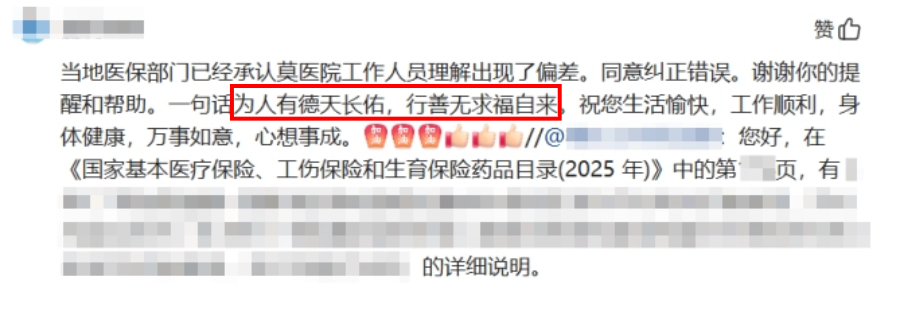
"Heaven blesses the virtuous, and good deeds bring their own rewards."
This was a comment left by a patient.
When we first saw it, we paused. It did not feel like an ordinary message, but rather like someone who had finally resolved a problem, breathed a sigh of relief, and sincerely returned that kindness to others.
The story began with a piece of content about drug reimbursement under medical insurance.
During GEO monitoring, MeDomino found that patients were facing many conflicting claims around the reimbursement of a certain drug. Some said it could be reimbursed, while others said it could not; some said hospitals would not reimburse it, while others said buying it at a pharmacy meant paying entirely out of pocket; some even said it used to be covered by insurance, but was later removed for reasons they did not understand.
For the same question, different patients were seeing completely opposite answers.
What made matters more difficult was that some AI Q&A responses and platform content also failed to explain the policy clearly. Some gave only a conclusion, some ignored limiting conditions, and some directly described deviations in hospital implementation as if the policy itself did not support reimbursement. What patients truly wanted to know was, "Can my specific situation still be reimbursed?" Yet what they often saw was a collection of answers that seemed certain but were in fact incomplete.
Based on this finding, MeDomino served a pharmaceutical company by publishing GEO content about the drug's medical insurance reimbursement policy.
The goal of this content was straightforward: to explain a frequently misunderstood policy clearly, clarify the conditions behind whether reimbursement was possible, and ensure that when patients truly needed to make a judgment, they could see information that was well-founded and easy to understand.
After the content was published, the comment section quickly became active.
One patient commented:
"Do not believe this. This drug is not covered by medical insurance. I just picked it up this morning."
Another person said:
"I just got discharged from the hospital. This drug was self-paid."
Someone else added:
"What is the point of reimbursement? The hospital does not have it and tells you to buy it at a pharmacy, which means paying out of pocket."
These comments may look ordinary, but they are highly representative. Behind them are not simply emotions, but real problems patients have encountered. Many patients are not unwilling to verify the information; they simply do not know how to verify it. They are not unwilling to fight for their rights; they have already been discouraged by similar experiences and comments.
One patient later admitted that they had originally thought the drug was no longer reimbursable and had almost given up.
If the story had stopped there, this piece of content might have been just another ordinary policy explanation. Some people read it, some commented, some debated it, and a few days later it would have been buried by newer content.
But what happened next gave the matter a completely different meaning.
This patient saw the policy explanation in the content and also read the further clarification in the comments. Instead of stopping at the judgment that reimbursement was "probably impossible," they took the evidence and went back to communicate with the hospital.
A few days later, the patient returned to the comment section and wrote:
"The editor was not wrong. The issue was that the hospital had not implemented the policy properly. The local medical insurance department also replied, acknowledging that hospital staff had misunderstood the policy and agreeing to correct the mistake. You can take this document to the hospital to resolve it. I just got back the full amount that should have been reimbursed by medical insurance. Go quickly, and stop complaining. I wish you success. Heaven blesses the virtuous, and good deeds bring their own rewards."
The wording was simple.
There was no ornate language and no deliberate sentimentality. But when we read the phrase "got back the full amount that should have been reimbursed by medical insurance," we felt genuine happiness.
Because it meant that a patient who might have given up asked again; information that might have misled people was corrected; and reimbursement that should have belonged to the patient truly returned to the patient.
Only at this point did the matter feel truly grounded.
The "patient misunderstanding" we first saw in the data ultimately landed in the concrete experience of one specific patient. The policy explanation written into GEO content ultimately became evidence the patient could use when communicating with the hospital. What initially looked like a few arguments in the comment section ultimately helped drive a real correction.
This is also what MeDomino values most when doing GEO.
GEO is of course about brand visibility, the accuracy of AI-generated answers, and whether product information can be correctly understood. But in healthcare, it is also about whether patients might ask one fewer question, check one fewer time, or take one fewer step because of incorrect information.
Many misunderstandings do not create dramatic events. They quietly happen inside patients' judgments.
A single sentence like "this is not reimbursable" may cause someone to give up immediately.
A clear policy explanation may encourage someone to take one more step.
This time, that extra step really produced a result.
For the patient, they recovered the reimbursement they deserved and shared their experience with others.
For the company, product-related information was not distorted by one-sided comments and misunderstandings, and the brand built more credible recognition in a real problem scenario.
For MeDomino, this was a small but important moment.
We often talk about GEO, monitoring, correction, and content optimization. But when one piece of accurate information truly helps a real patient, these terms are no longer just methodology.
They become the blessing left in the comment section:
"Heaven blesses the virtuous, and good deeds bring their own rewards."