One of the most stunning advances in large AI models in 2026 is Nano Banana's breakthrough in visual generation. This model, originally known for image generation, is changing workplace workflows in an unexpected way: generating PPTs from one sentence.
Unlike other AI PPT tools that choose templates and insert content in repetitive ways, Nano Banana brings a disruptive change. Users only need to upload a PDF or Word document, or paste a link, and within a dozen minutes they can receive a polished PPT ready for presentation.
- Customized style: a one-sentence description can generate a distinctive visual presentation
- Content accuracy: it extracts key points from source materials, and output depends directly on input
- Professional design: it has the aesthetic texture of a senior designer
Because of this, Nano Banana is regarded in the industry as one of the most outrageous, satisfying, and useful productivity tools seen so far.
The AI Productivity Revolution Behind One Speech
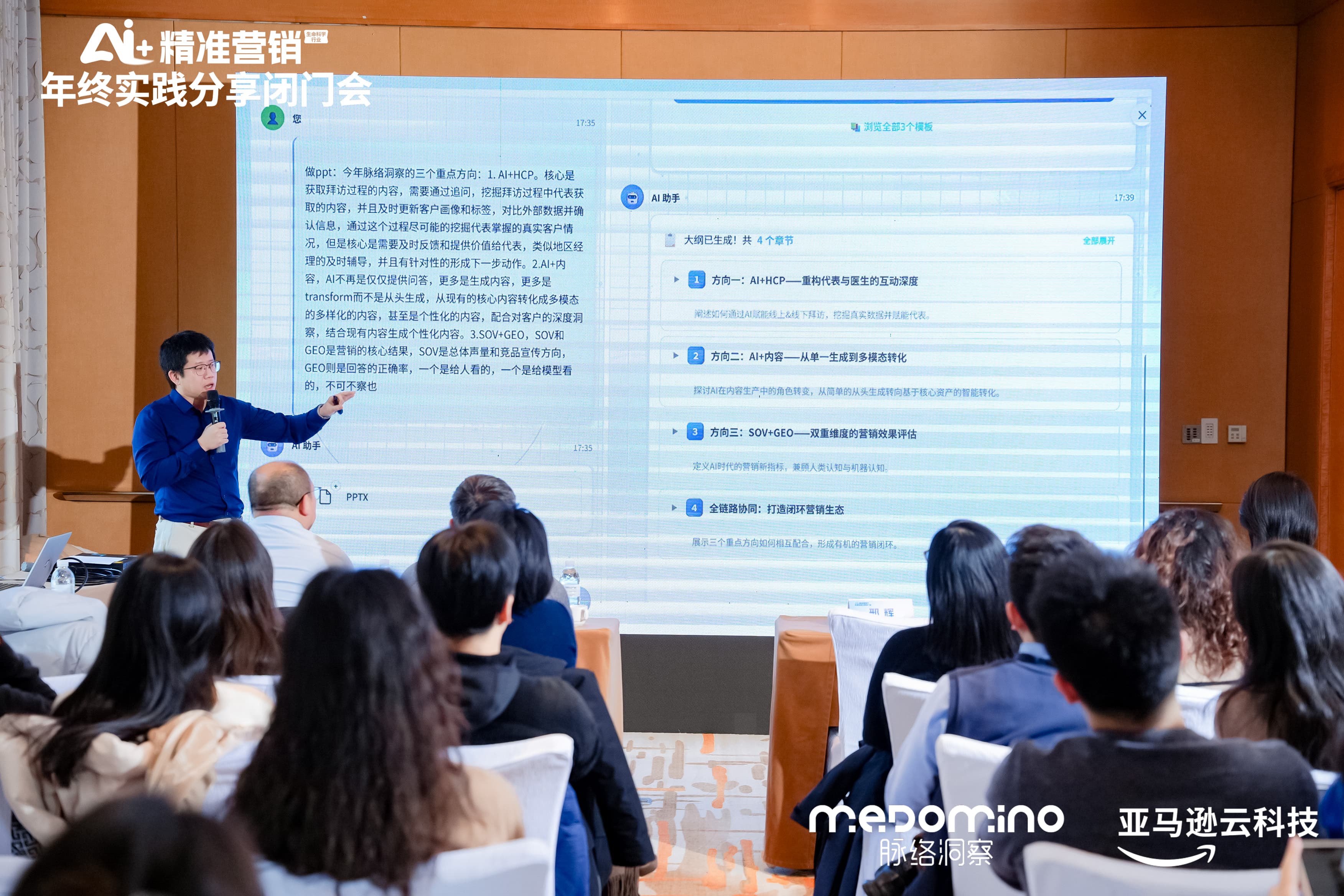
At an event co-hosted by MeDomino and Amazon Web Services on January 23, 2026, MeDomino founder and CEO Lu Wenqing delivered a keynote speech titled From Insights to Impact. The speech itself was the best presentation of the value of AI productivity tools: the PPT used by Lu Wenqing was automatically generated by Nano Banana.
No, this is not an ordinary story about using AI to make PPTs. What Lu Wenqing used was MeDomino Content Hub, an enterprise intelligent knowledge base connected to the Nano Banana model.
Lu Wenqing mentioned one detail in the speech. While preparing for it, he entered MeDomino's three key directions, AI enablement, content generation, and SOV/GEO, into MeDomino Content Hub. The system automatically generated the chapter outline, and its understanding of MeDomino and the life sciences industry was almost entirely accurate. After a simple adjustment to the outline, the PPT everyone saw was produced. He did not change a single word.
This is the real picture of AI moving from toy to enterprise productivity tool.
From Insights to Action: Does the Cook Stop Reading Recipes and Start Reading Strategy?
At this event, Lu Wenqing shared MeDomino's journey over the past few years.
The data insight stage
When MeDomino was first founded, it positioned itself as a data provider and was highly competitive in HCP data. It felt confident: it provided large amounts of data, built detailed tags, and produced many insights.
But the problem was: there were insights, but no results.
Lu's awakening
A small episode made Lu realize the problem.
Once, he needed to print a PDF document, but perhaps because the PDF was encrypted, printing kept failing. He had no choice but to ask AI for help. GPT analyzed the problem clearly and listed many possible causes, but could not solve it. Claude rewrote the entire document; the text was there, but charts were gone.
Finally, Lu decided to simply take screenshots page by page and print them. In less than ten minutes, the problem was solved.
High-sounding insights ended after being read, while the seemingly dirty manual action delivered the result.
Lu realized: "Maybe we should no longer only be MeDomino Insights. We should become MeDomino Action."
*Image for entertainment only. It is really not MeDomino's new logo.
Building enterprise productivity tools
To help life sciences move from insight to action, MeDomino has built two core capability lines:
The first line directly empowers sales visits
By deeply involving AI across the entire visit process, it guides frontline sales reps step by step:
- Before the visit: provide personalized visit suggestions based on external data and internal strategy
- During the visit: provide real-time Q&A and content support for sales reps
- After the visit: enter visit records by voice, let AI ask follow-up questions according to company strategy, structurally extract customer preferences and unmet needs, and provide next-action suggestions
The second line is content: multimodal content generation, or the MeDomino Content Hub mentioned earlier
In MeDomino Content Hub:
- The capabilities of leading general AI models are deeply integrated with years of enterprise knowledge-base content
- Content generation is not only based on public information, but also heavily cites existing internal product materials, research data, customer cases, and strategic knowledge
- Content production strategy shifts from creating from scratch to evidence-based intelligent recombination, ensuring all new content originates from compliant materials
However, MeDomino Content Hub is not connected only to Nano Banana. Whatever model the client needs, MeDomino can support it.
These core MeDomino capabilities upgrade AI from a personal toy into an enterprise productivity tool for life sciences. In fact, they are productivity itself.
Why Now?
Because AI capability made a qualitative leap in 2026:
- From answering questions to solving problems
- From single-turn dialogue to calling external tools and collaborating
- From generating content to delivering results. On January 27, 2026, Kimi released the K2.5 model, which can already reproduce code based on webpage interface screenshots.
In the AI era, the traditional product update pace of one CR every two months is too slow. MeDomino now iterates every two weeks.
Returning to the opening topic, when Lu Wenqing stood on stage and used a Nano Banana-generated PPT to tell MeDomino's AI transformation story, that scene itself was the best interpretation of From Insights to Impact.
In this surging AI era, what is truly liberated is not just individual PPT pages, but our attention. We no longer need to waste life on details like whether the title should use 24-point or 28-point font.
For life sciences companies, however, this AI revolution has only just begun.