Recently, "Lobster" became popular.
For many people, it made AI feel, for the first time, less like a consultant that answers questions and more like an assistant that can actually do work: opening software, operating browsers, organizing files, executing tasks, and connecting tools. So the phrase "one person plus one Lobster equals a team" spread quickly.
That excitement is understandable.
In the past, many AI products solved the problem of "generating answers." AI Agent products like Lobster made people see AI entering the stage of "executing tasks." It can not only talk, but also act. That is an important change.
But the hype faded quickly.
The reason is not complicated: it is imaginative, but not stable enough; it can execute tasks, but is hard to control; it can act automatically, but in many scenarios users do not dare to truly let go.
Once it enters serious work scenarios, the problems quickly become amplified.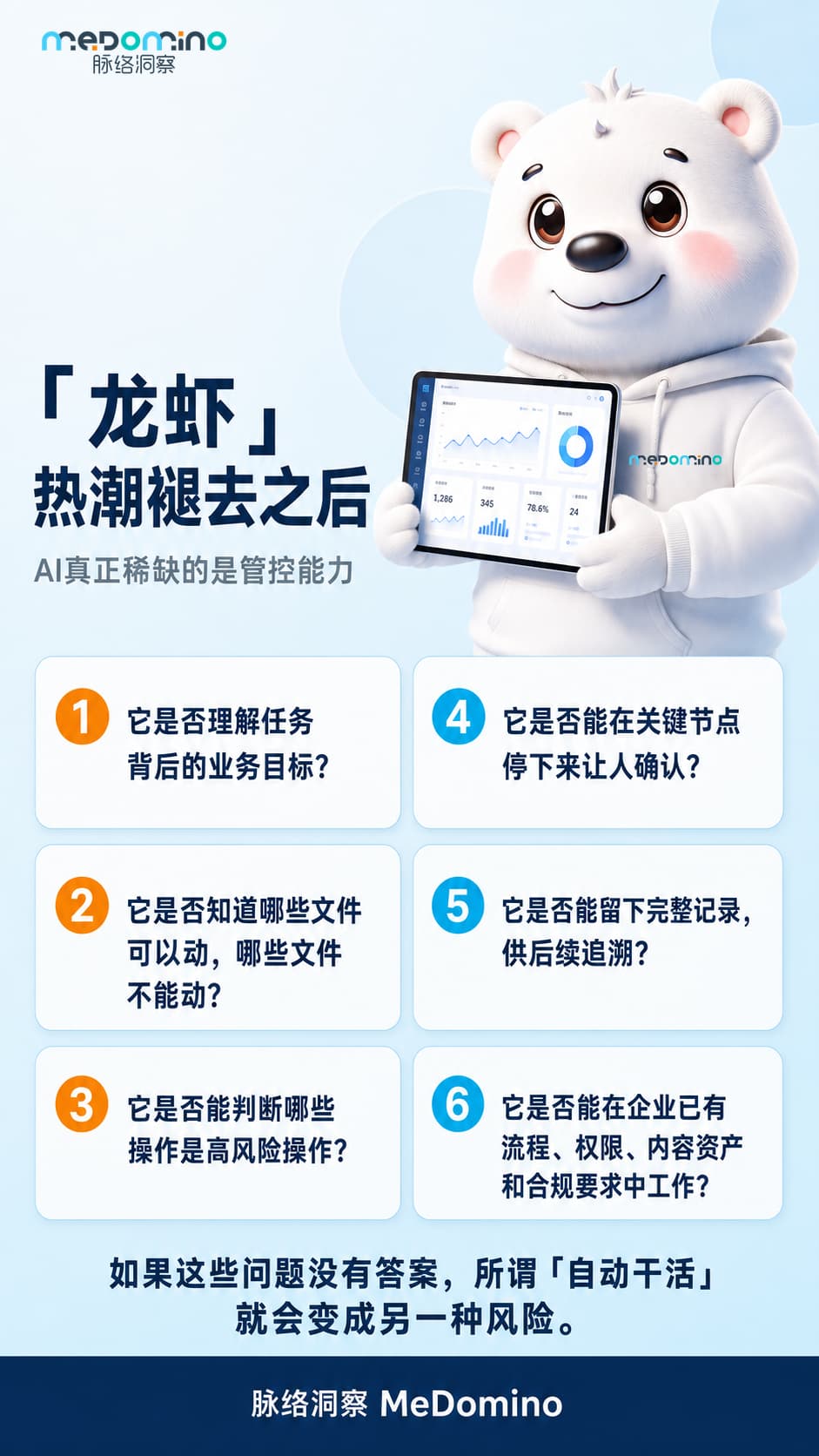
If these questions have no answers, so-called "automatic work" becomes another form of risk.
This is why many AI waves begin with amazement but quickly return to cautious use. It is not that AI has no value. It is that AI not placed inside a controllable system can hardly carry real production tasks.
For the life sciences industry, this issue is even sharper.
If a general-purpose Agent mistakenly deletes a file, the problem may be a loss of efficiency.
If a life sciences content generation system misuses evidence, crosses compliance boundaries, or generates inappropriate product statements, the problem is not just efficiency loss. It becomes medical accuracy risk, brand risk, and compliance risk.
So the lesson from the Lobster hype is not that AI Agents are unimportant.
On the contrary, it proves that the market strongly wants AI to truly enter workflows. But it also proves another point: once AI enters workflows, the scarce capability is not generation, but control.
Being able to generate does not mean being ready for production. Being able to execute does not mean being trusted. Being able to automate does not mean being ready for enterprise workflows. Being exciting does not mean making an organization feel safe.
The life sciences industry needs AI, but it needs AI that can be correctly constrained, correctly called, correctly reviewed, and correctly traced.
Especially in content production, AI cannot merely "know how to write." It must know what it is writing based on, why it writes that way, what evidence it cites, which customers it fits, which scenario it is used for, whether it crosses compliance boundaries, and whether it can be reviewed and reused.
This brings the issue to the next step: life sciences content generation cannot stay at a casual, loose, instinct-driven vibe generation stage. It must move toward harness generation.
The next stage of AI content generation is not more freedom, but more control.
The last AI Agent wave showed one thing: whether AI can generate and execute is no longer the only question. The real question becomes whether AI can work steadily within the right context and boundaries.
This is also why software development is beginning to move from vibe coding toward harness coding.
Vibe coding is a feeling-driven development approach. Users no longer write code line by line. Instead, they tell AI their ideas, feelings, and goals, letting AI generate code. Through continuous prompting, adjustment, and trial and error, they build a product that roughly meets expectations.
Its value is clear: fast, lightweight, and low-barrier.
But its problems are equally clear: unstable, uncontrollable, dependent on luck, and difficult to bring into serious production environments.
Harness coding follows a different logic. It does not let AI improvise freely. It puts reins on AI: clear task boundaries, context, toolchains, checkpoints, human intervention mechanisms, and quality control systems. AI still generates, but the generation process is placed inside a manageable, auditable, continuously optimizable system.
Life sciences content generation is going through the same transition.
Vibe generation means a feeling-driven generation approach. The user gives a rough intention, and AI generates results based on general knowledge and model capability. The process is lightweight, looks smart, and easily creates the intuition that AI can already replace a lot of work.
But the essence of vibe is weak constraint.
It lacks stable business context, clear process control, and compliance boundaries embedded in the workflow. It is suitable for personal experimentation, inspiration drafts, and low-risk content exploration.
But it is not suitable for serious content production in life sciences.
Because life sciences content cannot merely "sound right." It needs factual accuracy, medical evidence, alignment with brand strategy, adaptation to the target HCP's professional background and clinical concerns, compliance boundaries, and consistency across channels, scenarios, and customer journey stages.
The problem with many consumer AI products lies here. A user enters one sentence, and AI generates a piece of content. The user enters another sentence, and AI revises it again. It can be fluent and can sound professional, but it usually lacks three key elements.
First, it lacks human intervention points. AI generates in one pass. Users can only repeatedly modify the result, but cannot systematically intervene at key steps such as strategy, structure, evidence, expression, visuals, and compliance.
Second, it lacks the right context. If AI does not know the brand strategy, disease area, product positioning, target HCP profile, existing content assets, medical evidence system, and channel scenario, it can only generate generic content that looks acceptable.
Third, it lacks compliance control. In life sciences, content generation is not free creation. What can be said, what cannot be said, what needs evidence support, and what expressions carry potential risk must all be clearly constrained.
Therefore, the biggest problem with vibe generation is not that it is "not smart enough," but that it has not been placed inside the right business system.
The key to harness generation is not limiting AI, but unlocking AI's usability in serious scenarios.
It focuses not on "whether AI can generate," but on "how AI can be generated, reviewed, edited, reused, and distributed correctly."
Vibe generation focuses on what is generated; harness generation focuses on how it is generated correctly. Vibe generation relies on prompts; harness generation relies on context. Vibe generation repeatedly patches the result; harness generation continuously controls the process.
For life sciences marketers, this difference determines whether AI is a trial tool or a system that can enter enterprise-level content production workflows.
The life sciences industry does not need an AI toy that writes better by instinct. It needs a controllable, trustworthy, auditable content generation system.
This is exactly the product direction of the new version of MeDomino Content Hub: from casual generation to controllable generation; from generic generation to contextual generation; from result patching to process intervention; from a single-point tool to an enterprise content system.