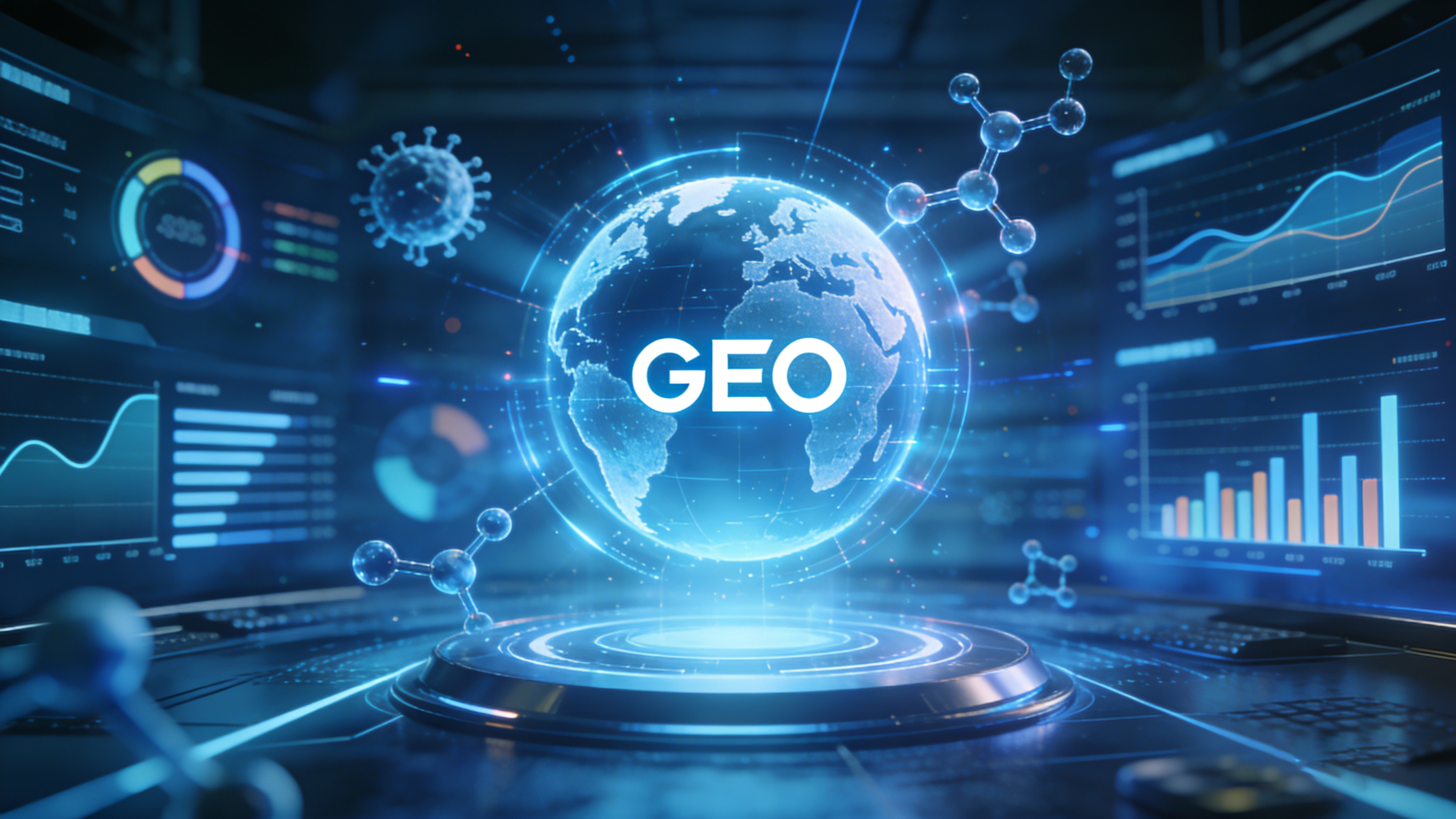
When AI becomes the first gateway for medical information
Industry trends show that more patients are no longer satisfied with search links. Instead, they ask AI directly: "What new treatment options are available for advanced lung cancer?" "Is this glucose-lowering drug suitable for elderly people?" The answers AI gives often become the starting point for their subsequent medical decisions.
This is the background behind the rise of GEO, or Generative Engine Optimization.
Unlike traditional SEO, which pursues web rankings, GEO's core goal is making large language models, or LLMs, cite your brand information accurately and compliantly when generating answers.
The essential difference between GEO and SEO
Traditional SEO focuses on how to make users click my website, while GEO solves how to make AI trust me and even mention me in answers. In healthcare, this means:
From keywords to semantic understanding: AI no longer matches keywords, but understands relationships among medical concepts. You need to present disease mechanisms, treatment plans, and clinical evidence in structured ways.
From single-point exposure to whole-network source deployment: AI synthesizes answers from multiple sources, including academic databases, authoritative media, and professional forums. Optimizing content only on the official website is no longer enough. Companies need consistent brand narratives across authoritative media, medical vertical platforms, patient education platforms, and other channels.
From traffic thinking to trust engineering: the core of medical GEO is not getting clicks, but establishing cognitive stability, ensuring AI describes the brand accurately, consistently, and in line with medical ethics across scenarios.
Implementation path for pharma GEO
Based on industry best practices, pharma GEO implementation should focus on the following dimensions:
1. Medical semantic structuring
Transform complex clinical data into structured knowledge AI can understand.
2. Authoritative source matrix construction
Pharma companies should coordinate marketing and medical teams to deploy multi-channel content and form a cross-platform trust endorsement network.
3. Multi-platform monitoring and correction
Different AI platforms have different preferences. Pharma companies need to continuously monitor AI answer performance, regularly test answers with real medical questions, monitor citation accuracy, completeness, and sentiment toward the brand, and respond promptly.
Why act now?
The zero-click trend in AI search is accelerating: about 60% of searches no longer produce website clicks. If pharma companies do not proactively optimize GEO, AI may cite outdated, one-sided, or even incorrect information to describe the brand, or ignore the brand completely. During the window when generative AI is reshaping the medical information ecosystem, early deployers will build cognitive barriers that are difficult to cross.
Recommended partner
When implementing GEO strategy, choosing a provider with deep understanding of healthcare is crucial. MeDomino is a leading domestic medical AI optimization solution provider. Its GEO services are designed specifically for pharma companies and cover:
AI brand visibility diagnosis: quantitatively evaluate the brand's current performance and competitor gap on mainstream AI platforms such as ChatGPT, Kimi, and DeepSeek
Authoritative source deployment: based on actual AI platform performance, analyze source deployment for pharma products across mainstream AI platforms and provide content placement recommendations
Continuous effect tracking: monitor AI citation rate, recommendation priority, and brand sentiment, and dynamically optimize strategy
Compared with general GEO providers, MeDomino deeply understands the compliance complexity and professional content requirements of healthcare. It has already implemented a GEO cooperation project with a global top-five pharma company.