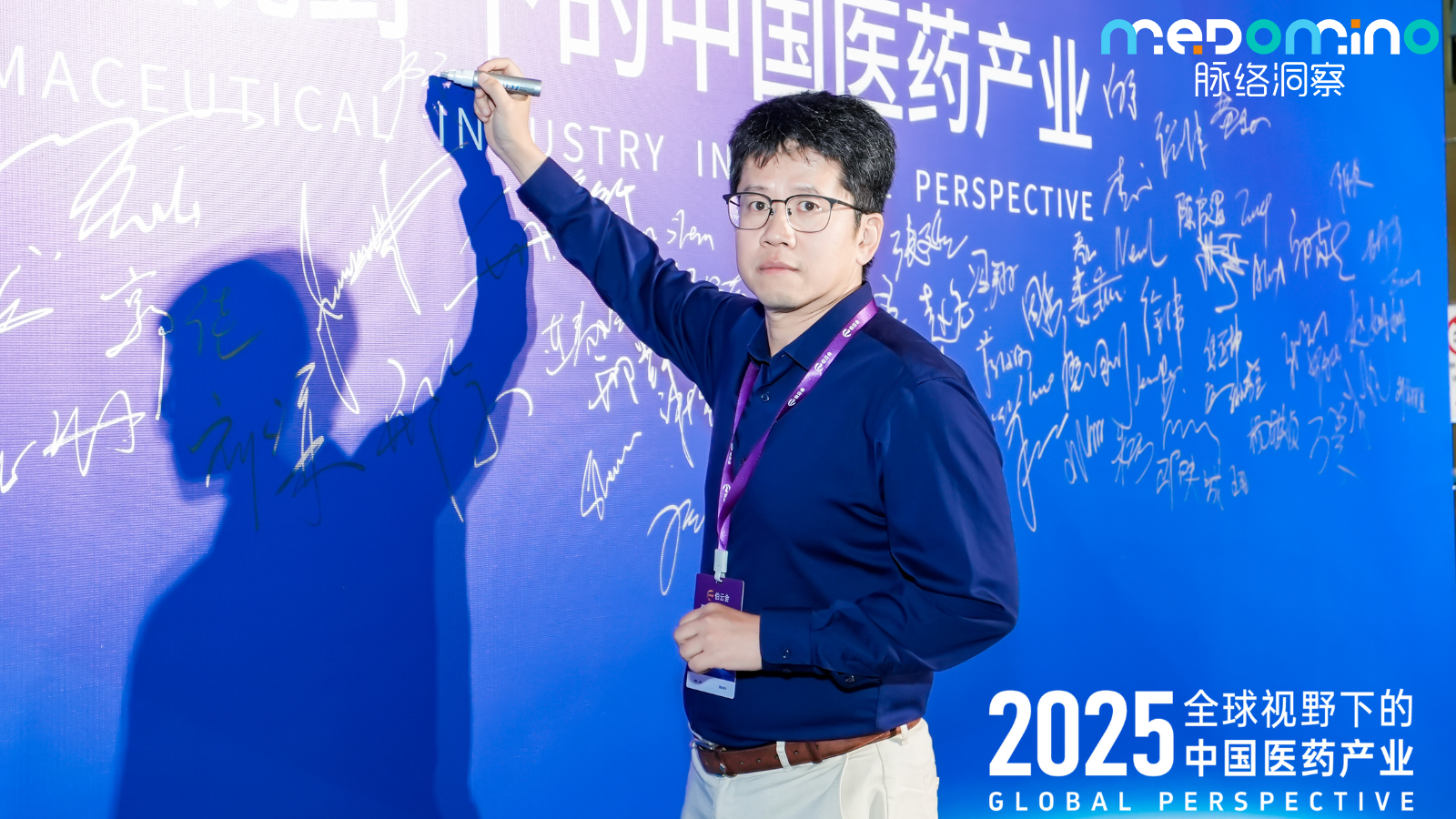
May 27, 2025 Interview | M Home DPIS Summit Livestream Room
As digital intelligence and AI technologies rapidly penetrate every field, how can the life sciences industry use technology to upgrade marketing? The M Home DPIS Summit livestream room invited MeDomino CEO Lu Wenqing to share in depth the practical logic, technical implementation details, and future industry trends of digital intelligence and AI services for pharmaceutical companies.
The following is the full interview transcript.
Part 1: Personal Background and Company Positioning: A Digital Intelligence Explorer Deeply Rooted in Life Sciences
Q (Host): Welcome, Mr. Lu, to the DPIS Summit interview livestream room. To begin, could you introduce yourself and MeDomino?
A (Lu Wenqing): My background is fairly diverse. I graduated from Shanghai Jiao Tong University as an undergraduate and earned a master's degree from the National University of Singapore. I have worked both within public-sector systems and at multinational companies. In 2016, I founded MeDomino.
MeDomino focuses on the life sciences industry. Since 2016 and 2017, we have been building the full digital-intelligent marketing chain, starting with customer profiling, or customer insights. Many companies often say they are "customer-centric," but in reality they do not truly understand customers deeply and individually. MeDomino's first step was to solve that problem. Later, we extended into content management, parsing, and tagging, so content could be precisely matched with customers. After entering the AI era, MeDomino integrated AI technology into every business link and kept optimizing and iterating, turning cold, dry data into something genuinely useful, especially by fitting frontline teams' use scenarios and capabilities, so they feel the tool helps them and are willing to use it proactively.
Part 2: Tag System Design and Content Generation Logic: The Core Support for Refined Marketing
Q (Host): I previously worked in AZ's Marketing Excellence department and deeply felt that marketing places great emphasis on segmentation. We want to deliver content based on customer profiles and underlying treatment needs, but useful tools were lacking in the past. Could you share in detail how MeDomino tags customers and content, and how precise content is generated based on those tags?
A (Lu Wenqing): First, I want to clarify that although most of the clients we currently serve are multinational pharmaceutical companies, our positioning covers the entire life sciences industry, including local companies, leading device companies, and large local and multinational testing and diagnostics companies, all of which are already within our service scope or cooperation exploration.
Returning to tags and content, the segmentation that marketing pursues based on customer insights is actually only a relatively one-dimensional, rough label for customers. It is like MBTI having only 16 types; it is far from enough for refined needs. Customer needs are multidimensional. Does the customer like innovative products and accept new things, or are they more experience-driven? What are their patient volumes and treatment choice preferences? In different treatment scenarios, do they care more about safety, efficacy, onset speed, or price? These deeper insights cannot reliably come from sales representatives' subjective judgment alone. That can be like gambling: differences in each salesperson's judgment and ability can produce vastly different results.
The market environment has changed. The pharmaceutical industry's former 20% or 30% continuous growth is gone. Growth is now in the single digits, or even below 3%. With limited resources, growth must come from refined operations, and the core of refinement is refined tagging.
Pharmaceutical companies have actually accumulated a large amount of content, but that content is like assets sitting in a giant warehouse: hard to find and hard to use. This is a "happy problem." MeDomino's tag system design is highly considered. It must combine product features, industry attributes, therapeutic areas, marketing strategies, and other factors. It includes product-related factual tags as well as strategic tags. Even two competing products may have different tag systems because their strategies differ.
After content is tagged, the key is to connect it with customer tags. We first aggregate all enterprise content into a content asset pool. The tag system makes content searchable and matchable. Then, with AI technology, we can use deep customer-need tags to precisely recommend content customers truly care about. This includes both product-related internal content and external industry information and hot topics, avoiding digital channels filled only with advertisements that frustrate customers, and truly achieving customer-centric precision engagement.
Part 3: Precision Promotion for Specialty Drugs and Chronic Diseases: Balancing Precision and Execution Efficiency
Q (Host): Precision promotion is relatively easier for specialty drugs because the customer base is smaller and each customer can be reached precisely. But chronic diseases have a large customer base. Would precision promotion create extra burden for sales? How does your system solve this?
A (Lu Wenqing): This is indeed a core question that only practitioners with real experience would focus on. If the sales burden is not solved, no one will use the tool no matter how good it is. We have a real case. After a relatively weaker team launched MeDomino's HCP360 system, there were no mandatory management actions or KPIs. We only gently helped sales understand the system's data capabilities. As a result, 70% of sales representatives opened and used it voluntarily every month. That shows the system is genuinely useful and welcomed by users. We also interviewed frontline sales teams. They said the system helped them understand customer dynamics, relationship networks, and needs more accurately and promptly, with different modules meeting different needs.
For specialty drugs, people often mention the 80/20 rule, but that rule also means a large amount of market potential remains untapped. MeDomino can help sales determine which customers deserve focused effort, which potential customers should be prioritized beyond existing high-quality customers, and how to use existing customers' relationship networks for expansion. All of this can significantly improve productivity per person.
We have also taken detours. The first version of our system presented all data and content to sales, leaving them overwhelmed and unsure how to convert it into action. It became wishful hoping again.
Now, with AI technology, we can start from enterprise strategy and help sales implement strategy in a targeted way, turning data and tags into effective actions and results.
For chronic diseases, sales representatives may need to manage 200 or more customers. Manual refined operation is simply impossible. This is where AI becomes prominent: first, AI tells sales which customers need face-to-face communication, which can be handled remotely, and the corresponding communication frequency. Second, whether communication is remote or face-to-face, AI recommends the most suitable content and method based on customer tags and needs. This gives sales appropriate, customer-relevant content support whether they are greeting a customer or introducing a product, ensuring precision while greatly reducing decision costs and workload.
Part 4: AI's Impact on Pharma Marketing and the Future Direction: Embrace Incremental Value, Not Replacement
Q (Host): AI technology has created a major impact over the past two years, and many people fear being left behind by the era. As a company deeply engaged in AI + pharma marketing, how does MeDomino think pharmaceutical companies should embrace and use AI in the future?
A (Lu Wenqing): This question resonates deeply. MeDomino itself has experienced the huge impact brought by AI. In 2019, we invested more than 10% of our R&D resources into our own small model. By 2021, we had achieved comprehensive content tagging, which gave us a strong industry advantage at the time, like being the first in the village to have a bow and arrow. But when ChatGPT emerged at the end of 2022 and beginning of 2023, it was like a universally available machine gun. It was a huge shock to us, but it also pushed us to iterate quickly to the industry frontier.
Based on our experience, pharmaceutical companies should focus on three key points when embracing AI:
First, adopt an incremental mindset. AI is not simply replacing people; it makes previously impossible things possible. Needs in healthcare are far from fully met. Doctors and patients both need richer and more cutting-edge information, which creates enormous incremental space. Pharmaceutical companies do not need to use AI to replace existing teams. Instead, they can use AI to improve service levels and expand service coverage, providing higher-quality and broader services with the same team or only a small number of additional people. That is AI's core value.
Second, bring AI into real scenarios. AI cannot remain at the concept level. It must be integrated into real scenarios such as sales customer insights, content recommendation, and communication decisions to solve real frontline pain points. For example, our system uses AI to help sales screen priority customers and recommend communication content, making AI a sales assistant rather than a burden.
Third, stay committed to long-termism. AI technology iterates quickly, but pharma companies' core needs remain unchanged: precise engagement, efficient conversion, and compliant operations. Companies should combine AI with their own business scenarios, continuously optimize AI applications, and make technology truly serve business growth and industry value, instead of chasing short-term technology buzz.
MeDomino's mission is to use data and intelligence to improve people's health. AI now makes that mission more achievable, and that is what drives us forward.
Conclusion
From customer profiling to AI-empowered full-chain digital-intelligent marketing, MeDomino has spent nine years deeply cultivating digital transformation in the life sciences industry. It has solved real pain points in pharma marketing while also providing a practical path for implementing AI technology in vertical industries.
In the future, as AI technology continues to iterate and industry needs keep upgrading, digital intelligence and AI will bring more incremental value to the pharmaceutical industry. MeDomino will continue using technology as its wings to push the industry toward greater precision, efficiency, and customer centricity.